Welcome to the Kataria Tech Zone blog!
Walk through any historic mandir in India and you’ll see centuries of patient chisel work frozen in stone — deities, floral motifs, geometric jali screens, and pillars carved with a precision that seems almost impossible by hand. That tradition of stone temple architecture hasn’t disappeared; it has simply found a powerful new tool. Today, CNC stone routers are helping temple builders, stone artisans, and construction firms reproduce that same intricate detailing with a level of consistency, speed, and scalability that hand-carving alone can no longer match at the pace modern mandir construction demands.
This guide looks at how CNC stone routers are being used in temple architecture, what makes them suited to carving mandir panels and pillars, and what to consider if you’re evaluating a machine for stone temple work.
The Enduring Legacy of Hand-Carved Temple Architecture
Indian temple architecture — from the Dravidian gopurams of the south to the Nagara shikharas of the north — has always been defined by dense, symbolic stone carving. Pillars wrapped in yali figures, ceiling panels with lotus medallions, and jali screens filtering light into geometric patterns are not decorative afterthoughts; they are structural and spiritual elements of the mandir itself.
Traditionally, this work has been the domain of skilled silpis (stone sculptors) working with hand chisels over months or even years per structure. That craftsmanship remains irreplaceable for the finest devotional detailing — but the sheer scale of modern temple construction, including large mandir complexes with hundreds of repeating pillars and panels, has made pure hand-carving a bottleneck. This is precisely the gap CNC stone routers are built to fill.
What Is a CNC Stone Router?
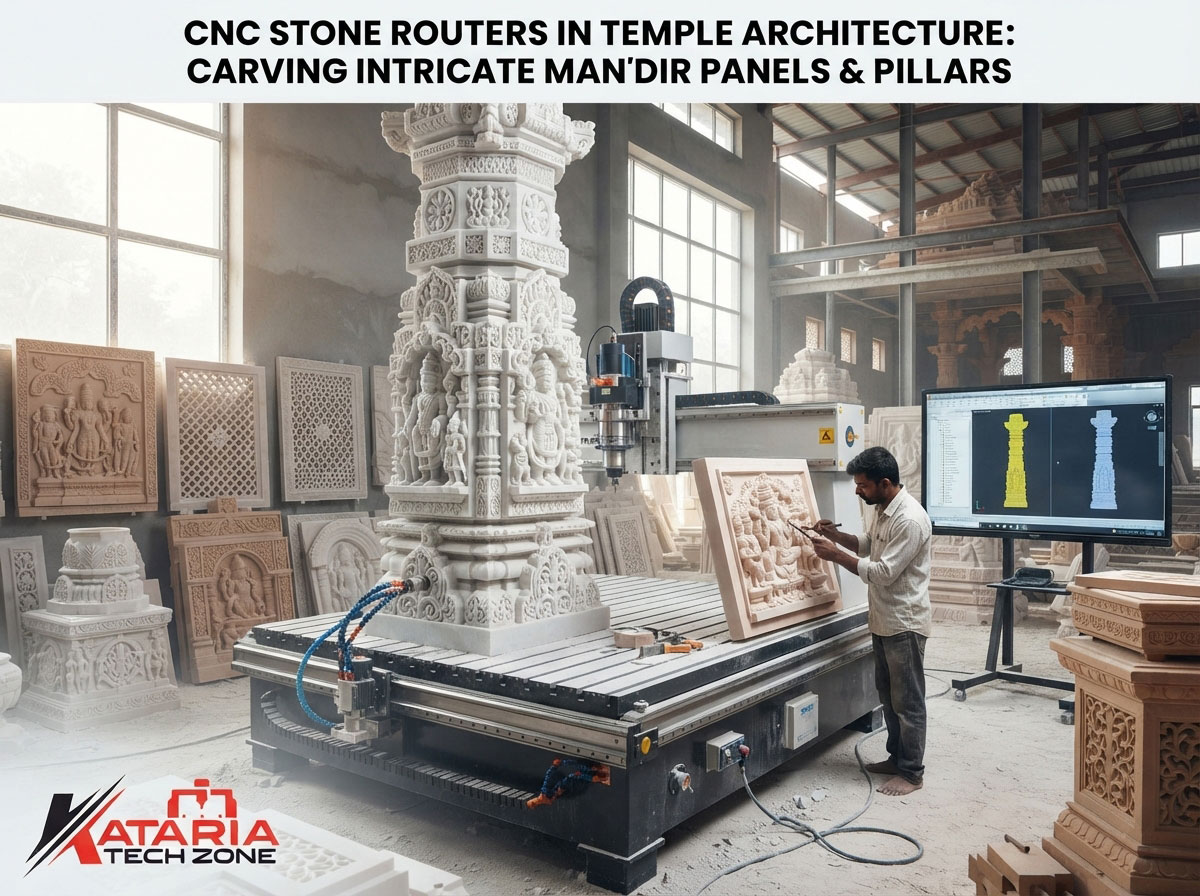
A CNC stone router is a computer-controlled cutting machine that uses a rotating spindle fitted with diamond-tipped or carbide router bits to carve, engrave, and shape stone — marble, granite, sandstone, and similar materials — based on a digital design file. Unlike a manual chisel, the machine follows a programmed toolpath with sub-millimeter accuracy, repeating the exact same cut across dozens or hundreds of panels without variation.
Most stone routers built for temple and architectural work include:
- A multi-axis spindle (typically 3-axis for flat panel relief work, 4- or 5-axis for pillars and rounded elements)
- Water-cooling systems to manage heat and dust during stone cutting
- A heavy-duty, vibration-resistant frame, since stone cutting generates far more resistance than wood or acrylic
- High-torque spindle motors capable of sustained cutting through dense material
Kataria Tech Zone’s CNC Stone Router Machine range is engineered specifically for this kind of demanding, continuous-duty stone work — built for the rigidity and cooling capacity that temple-grade carving requires.
Why CNC Stone Routers Are Transforming Mandir Construction
1. Precision at Scale
A mandir complex might call for 50 identical pillar sections or 200 matching jali panels. A CNC stone router carves each one from the same digital file, eliminating the natural variation that creeps in across months of manual carving by different artisans. This matters enormously for structural symmetry and visual harmony across a large temple facade.
2. Faster Project Timelines
Roughing out a deeply relieved panel by hand can take a skilled carver days. A CNC stone router can rough-cut the same design in a fraction of the time, leaving artisans to focus their hours on the fine, devotional detailing that machines still can’t replicate — deity expressions, ornamental finishing, and spiritual nuance.
3. Design Flexibility and Replication
Once a mandir panel or pillar design exists as a CAD file, it can be re-cut identically for future projects, scaled up or down for different temple sizes, or adapted with regional stylistic variations — all without recreating the carving process from scratch each time.
4. Reduced Material Waste
CNC toolpaths are optimized in software before a single cut is made, reducing the risk of costly errors on expensive marble or granite blocks — a real concern given how much raw stone material for temple work costs per cubic foot.
5. Safer, More Controlled Working Conditions
Manual stone carving involves prolonged exposure to stone dust and repetitive strain from chisel work. CNC stone routers, especially with integrated water-cooling and dust management, reduce the health risks associated with prolonged manual stone-cutting.
Key Design Elements CNC Stone Routers Excel At
Mandir Pillars (Stambhas)
Temple pillars often carry repeating floral bands, figurative carvings, and fluted or faceted profiles running the full height of the column. A rotary 4th-axis CNC stone router can carve continuously around a cylindrical or faceted pillar blank, maintaining consistent depth and pattern alignment from base to capital — something extremely difficult to guarantee by hand across a tall column.
Relief Panels and Wall Friezes
Deep-relief panels depicting deities, scenes from scripture, or ornamental borders are where CNC stone routers show their real strength. The machine can rough out the background depth and primary forms with high accuracy, dramatically reducing the material-removal time before an artisan steps in for final detailing.
Jali (Lattice) Screens
Geometric jali work — the perforated stone lattice screens used for ventilation and light filtering in mandirs — depends on extremely precise, repeating geometry. CNC routing is particularly well suited here, since the toolpath can cut identical, perfectly aligned openings across a large screen panel without the risk of a single misaligned cut compromising the pattern.
Shikhara and Dome Elements
Curved shikhara (temple spire) segments and dome elements often require compound curves carved into stone blocks. Multi-axis CNC stone routers can follow these curved surfaces far more consistently than manual layout and carving.
Decorative Bases and Plinths
Repeating lotus-petal bases, moulding profiles, and plinth detailing — elements that appear dozens of times around a temple’s foundation — are ideal candidates for CNC replication, since the design only needs to be perfected once.
Choosing the Right CNC Stone Router for Temple Work
If you’re evaluating a machine for mandir carving specifically, a few factors matter more than they would for general stone-cutting work:
- Bed size and working area: Pillar and panel dimensions for temple architecture are often larger than standard countertop or monument work — check the machine’s working envelope against your typical panel and pillar sizes.
- Spindle power and torque: Deep relief carving in granite demands significantly more spindle power than shallow engraving work.
- Water-cooling and dust extraction: Continuous stone cutting generates heat and abrasive dust; a robust cooling and extraction system protects both the spindle and the finished surface quality.
- Rotary axis capability: For pillars, columns, and any cylindrical or faceted element, a rotary 4th-axis attachment is close to essential.
- Frame rigidity: Stone cutting resistance is far higher than wood or acrylic; a lightweight frame will flex, chatter, and produce inconsistent carving depth.
- Software compatibility: Look for a machine that pairs well with CAD/CAM software capable of handling relief carving and 3D toolpath generation, not just flat 2D cutting.
Explore Kataria Tech Zone’s full CNC Router and CNC Stone Router Machine ranges to compare configurations suited to temple-scale carving projects.
Working With Different Stone Materials
Not all stone behaves the same way under a CNC router, and temple construction commonly uses several types:
- Marble: Prized for fine detailing and a smooth, luminous finish — ideal for deity idols, delicate panels, and interior mandir elements. Softer than granite, allowing finer toolpath detail, but more prone to chipping if feed rates aren’t controlled carefully.
- Granite: Extremely durable and weather-resistant, commonly used for exterior pillars, plinths, and structural elements exposed to the elements. Requires higher spindle torque and slower, more controlled cutting.
- Sandstone: A traditional favorite for temple carving across much of India, valued for its workability and warm tone. Cuts relatively easily but is more porous, requiring careful dust and moisture management.
- Laterite and local stones: Used regionally depending on availability; CNC settings need to be calibrated to each material’s hardness and grain.
Understanding these material differences — and adjusting spindle speed, feed rate, and bit selection accordingly — is central to getting clean, chip-free results on temple-grade stone.
From Design File to Finished Panel: The CNC Stone Carving Workflow
- Design and Digitization: The mandir panel, pillar, or motif is designed in CAD software, often based on traditional shilpa shastra proportions and iconographic guidelines, or digitized from an existing hand-drawn or physical reference.
- CAM Toolpath Planning: The design is converted into a 3D relief toolpath, with roughing passes to remove bulk material and finishing passes to define fine detail.
- Material Setup: The stone block is secured on the bed, and the machine is calibrated for the specific stone type, spindle speed, and cooling requirements.
- Roughing Pass: The CNC stone router removes the bulk of the excess material, establishing the overall relief depth and primary forms.
- Finishing Pass: A finer bit refines edges, depth transitions, and detail work, following a tighter toolpath for a smoother surface.
- Hand Finishing: Skilled artisans step in to refine facial features, add final texturing, and apply the devotional detailing that gives each piece its spiritual and artistic character — the step where machine precision meets human craftsmanship.
- Surface Treatment: Polishing, honing, or leaving a matte finish depending on the panel’s placement and traditional requirements.
This hybrid workflow — machine for scale and consistency, artisan for soul — is increasingly the standard approach for large mandir projects across India.
Combining CNC Precision With Traditional Craftsmanship
It’s worth being direct about this: a CNC stone router does not replace the silpi. What it does is remove the repetitive, physically taxing bulk-carving work from the process, freeing skilled artisans to spend their time where it matters most — the fine detailing, spiritual symbolism, and finishing touches that give a mandir its character. Many of India’s most respected temple construction firms are now running hybrid workshops where CNC roughing and traditional hand-finishing work side by side, producing results that are both faster to complete and true to centuries-old carving traditions.
Maintenance Considerations for Stone-Cutting CNC Machines
Stone routing is significantly harder on a machine than wood or acrylic cutting. A few maintenance practices matter more here than in other CNC applications:
- Regular spindle bearing checks, since continuous stone cutting places more strain on spindle components than lighter materials.
- Consistent water-cooling system maintenance to prevent overheating during long carving sessions.
- Frequent bit inspection and replacement, as diamond and carbide bits wear faster in dense granite than in marble or sandstone.
- Dust and slurry management, both for machine longevity and workspace safety.
A well-maintained CNC stone router, built on a rigid industrial frame, can reliably support years of continuous temple-scale carving work.
Bringing CNC Precision to Your Mandir Project
Whether you’re a temple construction contractor scaling up pillar and panel production, or a stone workshop looking to add CNC capability alongside your artisans, choosing the right machine makes the difference between a project that stays on schedule and one that doesn’t.
At Kataria Tech Zone, we build CNC stone routers designed for exactly this kind of demanding, continuous-duty carving work — from mandir pillars and relief panels to jali screens and architectural detailing. Explore our CNC Stone Router Machine range, browse our broader CNC Router lineup, or read more CNC and woodworking insights on the Kataria Tech Zone blog.
Have questions about which machine configuration suits your temple carving project? Get in touch with our team — we’re happy to walk through spindle, bed size, and rotary-axis options based on your specific pillar and panel dimensions.